

Our Family Law Team hosted a symposium at 1 The Sanctuary, Westminster, to explore whether there needs to be a change in culture in the courts’ approach to domestic abuse allegations in financial applications made in family law matter. Nicholas Thompson, a Trainee Solicitor in the team, summarises the event.
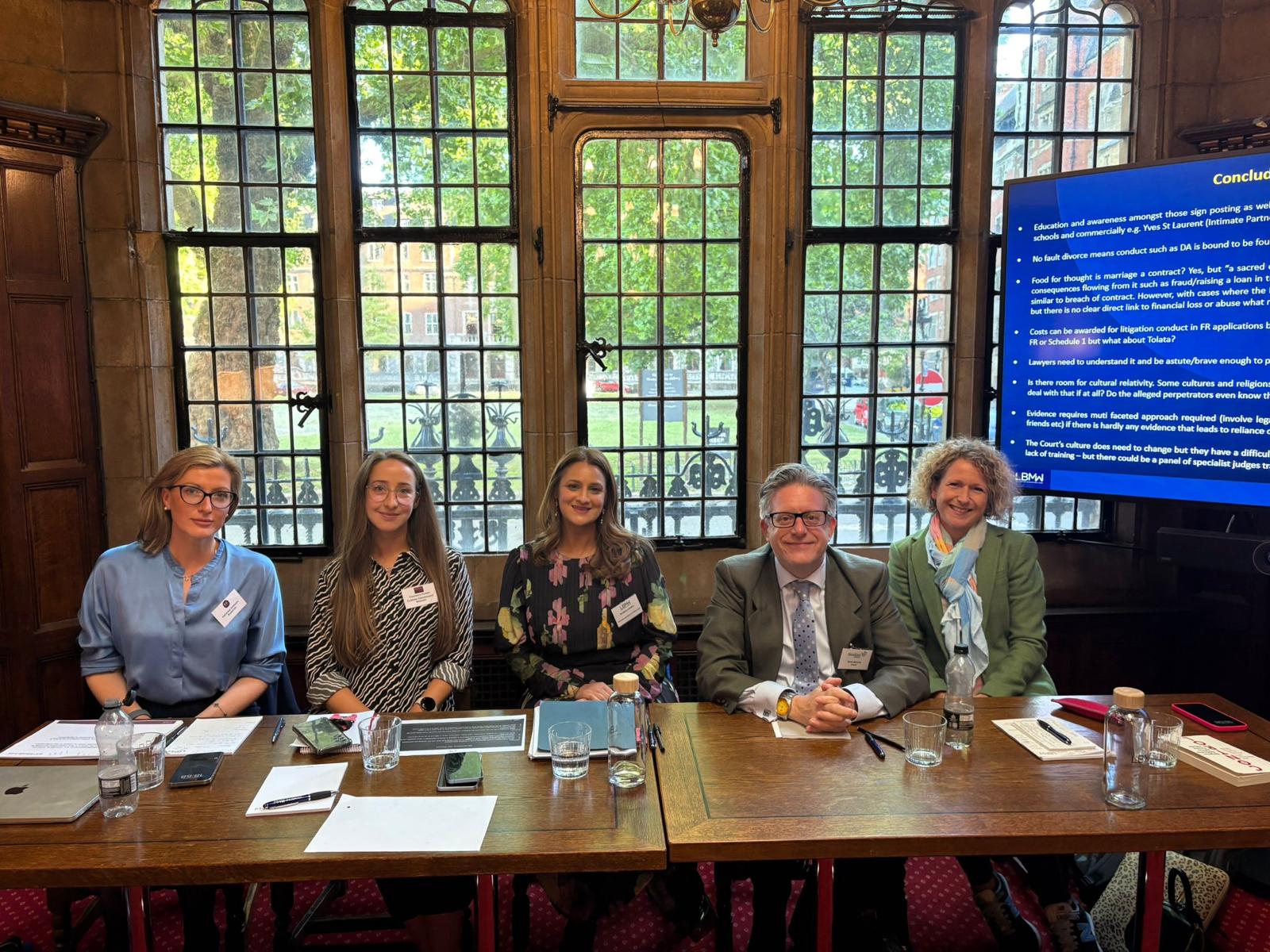
Resolution, the Solicitors Family Law Association, held a working party in 2023 which concluded that a cultural shift is required for family advisors to consider how the added sum in remedy of domestic abuse is quantified. This working party’s findings formed the basis of a panel discussion chaired by Shameela Ahmed, Partner and Head of Family Law at Lee Bolton Monier-Williams LLP, between Katherine Dunseath, Junior Barrister at 1GC Family Law, Francesca Ferrier, Economic Empowerment Manager at Refuge, Mark Brooks OBE, Chairman of the Board of Trustees of The Mankind Initiative, and Arabella Paul, Founder of The Divorce Survival Coach.
Katherine Dunseath began by discussing N v J [2024] EWFC 184 which provides the leading guidance on the court’s approach to domestic abuse as well as Peel J’s explanation of the relevant test at Tsvetkov v Khayrova [2023] EWFC 130, paras [43] – [46]. Ms. Dunseath noted the risk of an adverse costs order should a domestic violence challenge prove unsuccessful. However, the contrary judgment by a Northern Ireland first instance Master in Seales v Seales [2023] NIMaster 6 was also considered.
The existing position, as shown in the judgments of Sir Jonathan Cohen KC, is that financial consequence of domestic abuse must be evident. Ms. Dunseath advocated for reform of this maxim to expand to running conduct. In opposition to this, one might argue that such expansion would risk a floodgates scenario. Ms. Dunseath dismissed such criticism as an assumption, likely unfounded, that most people running conduct claims are fabricating issues. If one runs conduct, one increases costs. One therefore reduces an already diminished pot. There is, therefore, little incentive to fabricate issues of conduct. In order to replenish a pot diminished by economic abuse, Moor J provides guidance on addback arguments to make the spender put funds back into the pot for splitting between the parties.
Ms. Dunseath closed by remarking that, sometimes, a solicitor is the first person someone sees when a relationship breaks down. They must, therefore, act as sign-poster for other vital services such as charities, medical assistance, counsellors, and therapists. Such sign-posting may also be beneficial to the legal case as many clients may only realise that they have been subject to coercive behaviour after speaking with other types of professionals. There is also a balance to be struck between a full and fair settlement and the client’s ongoing mental health. In some cases, one may need to go all the way to court to address domestic abuse issues, but this may not be beneficial for most clients who may still be coming to terms with what has happened.
Next, Francesca Ferrier spoke about her experience supporting survivors of abuse with Refuge. Ms. Ferrier noted that, whilst survivors may struggle to resolve their financial circumstances following abuse and coerced debt can be more difficult to prove than other forms of economic abuse, fraud mechanisms are open to survivors. The most common forms of fraud are romance fraud or where they are perpetrated by someone who knows the victim. Nobody goes into a domestic abuse relationship with open eyes. Economic abuse drips-into a relationship slowly over prolonged periods.
Ms. Ferrier noted that treatment of economic abuse has lagged behind other forms of domestic abuse, with economic abuse only being officially recognised in 2023 when that part of the Domestic Abuse Act 2021 came into effect. Additionally, the acceleration of financial technology has widened the variety of economic abuse which can occur. Perpetrators may have access to online accounts with real-time locations of where survivors’ transactions take place. If an abuser controls a survivor’s accounts and devices, they can control their life. This leads to gas-lighting and a breaking-down of the sense of self. Another example is the advent of smart fridges in the home. These have been used by some abusers to control what is being eaten and by whom.
Changes in technology have also had an impact on evidence. For example, recordings of conversations and online message exchanges now undergo rigorous testing before they can be admitted as evidence in case they have been tampered-with by either party. Such processes can re-traumatise survivors as such evidence is often obtained at great personal exertion.
Ms. Ferrier additionally noted that financial harm is not always as straightforward as one might think. For example, an abuser may sabotage formerly joint assets or continue to hide or spend funds. More safeguards are, therefore, required to protect survivors from ongoing abuse. Technology continues to pose a threat to survivors once they have moved out of the abusive relationship. For example, an abuser may gift devices to children in order to monitor survivors. Refuge is training magistrates in how to word non-molestation orders so as to minimise the opportunities for abuse to continue in this way.
In finance, the FCA Consumer Duty Guidance now includes Economic Abuse in their definition for Vulnerable Customers, ensuring that survivors will be better-supported in future by their banks following economic abuse. At present, there remain huge inconsistencies even within the same banks. Survivors need to be believed first time. They often have many hurdles to overcome in re-building their lives and typically survivors of economic abuse have six creditors to deal with.
Third, Mark Brooks OBE explained that there is more in common between male and female victims than there are differences. Mr. Brooks then cited various cases which caught media attention, including a public case of domestic abuse where the victim was eventually murdered by his wife. He also added that economic abuse often continued long after the end of the relationship. An example of this is the abuser going through the family courts from prison (having been imprisoned as a result of their abusive behaviour) and benefitting from full legal support by virtue of their being imprisoned, thereby further diminishing the survivor’s financial resources.
In recent years there have been noticeable increases both in same-sex economic abuse cases and in use of the family courts for economic and psychological abuse such as repeated failure by the abuser to attend hearings, which increases legal fees considerably.
With male survivors, it is also important to recognise that domestic abuse is quite a technical and loaded term. Most middle-aged men do not understand the ‘domestic abuse’ label but can discuss their lived experience of their day-to-day relationship. It is therefore key for supporters of survivors to cultivate a professional curiosity with open questions which the survivor can direct onto the ground most comfortable to them.
In the family courts, the judiciary often do not conceptualise levels of risk and harm in the same way for men and for women. However, there are other factors which also influence their judgment, including social class and ethnicity, to a greater extent than gender. Members of lower social classes are more likely to suffer domestic abuse and are more likely to lack sympathy from their peers when this occurs.
Finally, Arabella Paul put forward her toolkit for helping survivors through divorce and beyond. This includes:
- empowering linguistics, turning phrases such as “I am broken” into “I have survived something incredible” and “my limits” into “my capabilities”;
- preparing mission statements;
- identity work;
- changing modalities through physical activities;
- understanding a gameplay checklist in order to recognise their partner’s behaviours to validate and clarify what they have been exposed to;
- developing the ‘grey rock’ or ‘canned response’ approach through facts-only responses to their former partner;
- use of co-parenting apps for documented and timestamped interactions and information-sharing; and
- developing a regular exercise routine with exercise buddies.
Ms. Paul’s clients need both legal and emotional support from economic abuse. The resultant gas-lighting leads to an inferiority complex. This can be combatted through power-dressing, mantras, associating feeling confident with a particular song, breathing strategies, finger-tip grounding, speaking one’s truth, role-playing in preparation for court and ensuring sufficient safety measures are in place, planning a friendly face and hot meal for after court, and ensuring that the typical escalation of abuse which follows separation is mitigated.
In plenary discussion, the floor turned the conversation to consider ethnic stigmas such as those felt by, for example, various south Asian diaspora who come from a culture which considers it taboo to discuss things like domestic abuse openly. These women are struggling to find their voice. The family courts often struggle to support them because partners by religious marriages which have not been registered are treated as cohabitees rather than as husband and wife. The law therefore affects such people in a disjointed manner. Ms. Ferrier noted that barriers are already high for a victim to get to the point of being considered by the courts. On average, it takes seven attempts to leave before a victim succeeds in leaving.
In considering financial remedies to domestic abuse, the panel wondered whether marriage should be considered a contractual agreement. Judges could therefore write letters to the credit reference agencies to re-build the victims’ credit scores. Other considerations included a fixed training plan, with allotted funding, so that, where a victim has been forced not to have a career or develop skills, they can have the opportunity to re-train and become self-sufficient.
In discussing such options, it is important to be circumspect of cultural relativity. There are several opposing models of family operating within British society, some patriarchal, some matriarchal, some 50:50, and many others. The panel considered an example where a man pays for everything, and the wife keeps all her own funds separate. Does the man have the right to argue that his wife never contributed anything financially to the marriage? Does the woman have the right to argue he controlled everything because he paid for it? This is where cultural relativity plays a key role. In any society, the victim has a fear of the consequences of trying to act differently to the status quo and this will influence their judgement and their actions. Some people like the arrangement they have in place. The element abuse comes-in if they try to change it and their partner stops them.
In court, reliance on a victim statement alone is a risk. Evidence should involve a victim’s legal team, GP’s findings, counsellors’ opinions, mental health professionals’ reports, and statements from friends and other third parties. This is particularly important where the victim has a lack of financial literacy in relation to how mortgages, joint accounts, and household finances operate. Financial wellbeing is linked with mental wellbeing and, as above, with domestic abuse. The prevailing guidance remains N v J so lacking evidence of domestic violence makes the cost of bringing such arguments a deterrent with limited prospects.
The symposium concluded that additional training, including trauma-informed training for barristers, solicitors, and judges, should be complemented by updated practice directions. Such practice directions should be prepared in comparison with present Australian guidance reform and in consultation with the major charities in the field, such as Refuge and The Mankind Initiative.
We would be happy to assist anyone who may need support in bringing domestic abuse allegations in financial applications or in any family law proceedings. A professional approach is always advisable to minimise the risk of prolonged and costly litigation.
Please contact Shameela Ahmed, Laura Tester, or Nicholas Thompson on 0207 222 5381 to discuss this further.